Hidden-line solids
A solid drawn the way a draughtsman draws one: the faces in one color, and in ink only the lines that describe the form. Those are the creases, the boundary, and the silhouette. A crease is where two faces meet at an angle, a boundary is where a surface ends, and the silhouette is where it turns away. A box gives its twelve edges and none of the diagonals its faces are built from, and a sphere gives its outline. The faces hide what is behind them, so a near solid hides the edges of a far one.
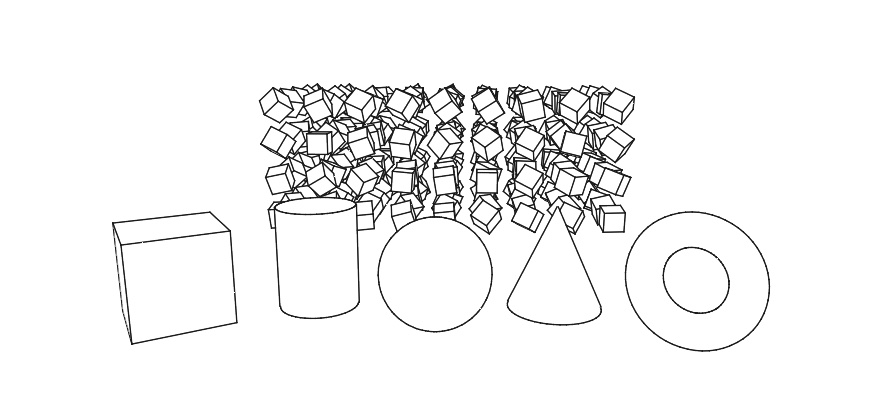
let copies = (0 ..< 100).map { MeshInstance(position: Vector3(Double($0 % 10), 0, Double($0 / 10)), scale: 0.3) }
background(.white)
fill(.white)                       // the faces: the paper's color
stroke(.black)
strokeWeight(1)                    // one point on screen, near or far
featureEdges()
drawBox(size: 1)
drawMesh(.box(size: 0.3), instances: copies)   // every copy's edges in one more draw
Which edges are drawn
featureEdges(creaseAngle:) turns the mode on for the meshes drawn after it, and noFeatureEdges() turns it off. The faces draw as they always do, in the current fill and the current lighting and material. Over them, the mesh's edges draw in the current stroke at strokeWeight. Three kinds of edge are drawn:
- A crease, where the two faces on either side meet at more than
creaseAngle, in radians. The default is π/6, 30 degrees. A box's edges meet at 90 degrees and are all creases. A sphere's facets meet at about 11 degrees, and none of them is. - A boundary, where a surface ends: the rim of an open cup, the edge of a plane.
- The silhouette, where the surface turns away from the eye. It is worked out for every copy from where that copy is seen, so a sphere drawn a thousand times shows a thousand outlines.
A creaseAngle of 0 makes every edge a crease, the diagonals included, which is a wireframe whose hidden lines are taken out. A larger angle keeps only the sharper folds. Corners the mesh holds once per face, as a box does for its hard edges, are joined first, so they never read as a boundary.
The state is saved and restored by withState. noStroke() leaves the edges out, and wireframe() wins over the mode. A gradient stroke draws the edges in the color at the middle of its ramp, with a note. strokeDash, strokeBrush, and strokeProfile shape a flat stroke, so the edges draw whole at one weight while they are on, with a note.
In front of and behind
The faces write depth before their edges are drawn, and each edge takes the depth test.
- A solid in front hides an edge exactly where it covers it.
- A face never hides its own edges. An edge's depth is pulled a little toward the eye, as a line in 3D is.
- A silhouette sits just outside the solid's outline, so the faces seen nearly edge on at a curved surface's rim cannot cover it.
- A crease that turns away, one whose two faces both face away on a closed mesh, is left out. The mesh's own front hides it anyway, and leaving it out keeps it from showing where the depth pull reaches past a thin solid's front.
The pull has the line's cost. Two solids can nearly touch, within about a hundredth of their distance from the eye. There, the edge of the one drawn first can show through the face of the one drawn after. Copies drawn in one drawMesh(_:instances:) call are free of this, since all of their faces are drawn before any of their edges. Meshes drawn one call at a time are drawn in call order.
A weight on screen or in the world
The weight follows strokeWeight(_:in:). In .screen units, the default, it is canvas points, so a 1-point weight is a hairline on every copy whatever its size or distance. In .world units it is the scene's own units, scaled by each copy's scale, and it thins with distance like a wire.
Many copies
Under drawMesh(_:instances:) the edges of every copy are one more GPU draw beside the solids, placed by the same matrices. The CPU does no work per copy. The form whose placements a compute kernel writes, drawMesh(_:instances:count:), takes them the same way. A mesh's edges are found once and kept while the mesh goes on being drawn. So a mesh drawn every frame is searched for its edges once. A mesh changed since it was last drawn is searched again. So a mesh rebuilt every frame pays the search every frame. That is about half a microsecond a vertex on an M2. A mesh of 1.2 million vertices took 0.6 seconds a frame with its edges, and 30 milliseconds without.
A mesh field draws its faces without their edges, with a note, because its GPU cull has no edges to cull yet. Draw the copies with drawMesh(_:instances:) when they need their edges.
Where the edges go
- Exports. A still, a video, and the temporal anti-aliasing and motion-blur passes draw the edges in every pass, the way the window does. Depth of field reads their depth like any solid's. A path-traced export draws them over its picture, depth-tested against the traced scene.
- A vector export (SVG, and the plot formats built on it) leaves solids out, and their edges with them. Line drawing writes a scene down as the same kind of line work, as paths a plotter can follow.
- Not carried: the edges are lines, not geometry, so they cast no shadow and a traced reflection does not show them. A spatial export (USD) carries the solids and leaves the edges out. A web page export stops at 3D drawing and names it, and the sketch exports as video instead.
What it costs
The CPU cost is next to nothing once a mesh's edges are known. The GPU draws six vertices for each edge of each copy and shades the pixels the lines cover. On an M2 at 1080 by 1080, the HiddenLines example draws 10,648 boxes in 4.2 milliseconds of GPU time for the solids alone. With 1-point edges that becomes 8.3 milliseconds, and with 2-point edges 11.5. The CPU time stays at about 5.4 milliseconds a frame either way, and that is spent placing the boxes. Drawn as a drawLine per edge instead, the same edges cost about 200 milliseconds of CPU time a frame.
See also Lines in 3D for a line between points in space, and 3D for a mesh drawn as all of its triangle edges. outline(width:color:) draws an ink line around a solid's silhouette alone, and Instancing covers drawing many copies. The HiddenLines example turns ten thousand boxes in a block of air with their edges inked.