Steering behaviors
A steering creature moves as if it had intent, and one simple move is all that takes. Aim at full speed toward what you want, subtract the velocity you already have, then cap the turn. Every behavior is that same move with a different idea of what you want, so behaviors combine. Scale each force, add them together, and the creature balances the things it wants. This is Reynolds' autonomous-steering model, the single-creature side of flocking.
Vehicle is a creature you hold on to, and it keeps its own state. Each behavior method returns a force, applyForce(_:) adds up the ones you choose, and step() moves the creature. A Vehicle is deterministic for a given seed, because only wander draws random numbers, so a seeded creature retraces the same path.
let creature = Vehicle(at: center, seed: 1)

override func draw() {
    creature.applyForce(creature.wander())
    creature.applyForce(creature.contain(in: bounds) * 1.5)
    creature.step()
    fill(.white)
    drawVehicle(creature)
}
Contents
The steering move
Vehicle(at: Vector2, velocity: Vector2 = .zero,
        maxSpeed: Double = 3, maxForce: Double = 0.12, seed: Int = 0)
maxSpeed is the top speed. maxForce caps how sharply the creature can turn on each step, so a low value turns smoothly and slowly, and a high value snaps around. The steering move itself is public:
creature.steer(toward: direction) // aim at maxSpeed along direction, minus velocity, capped
position, velocity, and heading are the live state, and you can draw them however you like. drawVehicle(_:size:) draws a triangle that points along the heading, using the current fill.
The behaviors
Each behavior returns a force to pass to applyForce(_:), and you scale that force to make it stronger or weaker.
| Behavior | What the creature wants |
|---|---|
seek(_ target:) | reach the target at full speed |
flee(_ target:) | get away from the target |
arrive(at:slowingRadius:) | reach the target and stop there (speed ramps down inside the radius) |
pursue(_:velocity:) / pursue(_ other:) | intercept a moving target by aiming where it will be |
evade(_:velocity:) / evade(_ other:) | escape a moving threat by fleeing where it will be |
wander(radius:distance:jitter:) | roam with no target, by seeking a jittered point on a circle projected ahead |
follow(_ field:) | move along a FlowField |
follow(path:radius:lookAhead:closed:) | stay inside a corridor along a path, described below |
separate(from:radius:) | keep some space from the other vehicles |
contain(in:margin:) | stay inside a rectangle (pushed back near the edges) |
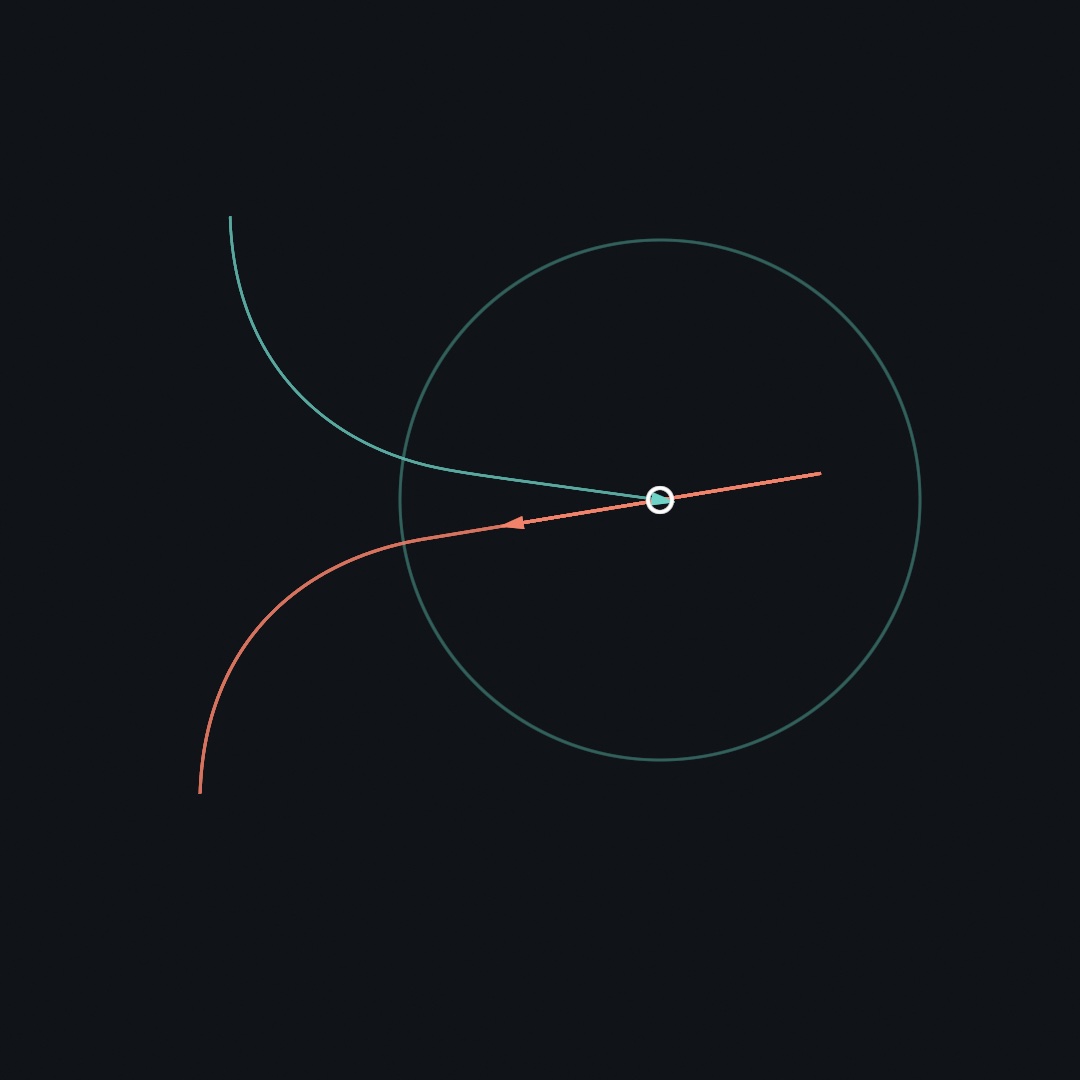
wander is the one behavior that uses the seed. A small jitter drifts in long arcs, and a large one is twitchy. Give each creature its own seed, or they all wander the same way at the same time.

Following a path
creature.follow(path: points, radius: 20, lookAhead: 50, closed: false)The creature predicts its own position lookAhead ahead of where it is now. If that prediction strays more than radius off the polyline, the creature seeks a point further along the path. It rejoins the path ahead of itself, instead of cutting straight back. While the prediction stays inside the corridor, the behavior returns no force. Pass closed: true for a loop, and the walk ahead then wraps through the seam. The path can be streamlines from a flow field, the points of a Contour, or any list of points.
Combining behaviors
Scale each force to give it a weight, and let the caps resolve the conflict between them:
creature.applyForce(creature.follow(path: loop, closed: true))
creature.applyForce(creature.separate(from: troop, radius: 26) * 1.2)
creature.applyForce(creature.evade(threat) * 2)
creature.step()
For a whole flock with neighbor rules (separation, alignment, cohesion), use Boids, which runs the same steering move over a spatial hash. Vehicle is for the handful of creatures whose behavior you direct one by one. See the Motion/Steering example, which has a path troop, wanderers, and a pursuer.
Related: Flocking (boids) (the same steering at flock scale), Flow fields (fields a creature can follow), Physics (force-driven motion with collisions).