Tensegrity
A tensegrity is a structure of rigid struts that never touch, held up by a net of cables. The struts push, the cables pull, and the form stands because every push meets an equal pull. Tensegrity is the geometry: nodes in space, the struts between them, and the cables between them. Three classic forms come ready-made in their balanced shape, and any of them can be handed to a World3D to fall, land, and stand.
let ball = Tensegrity.icosahedron(strutLength: 2)    // the six-strut form

fill(.white)
drawTensegrity(ball)                                  // struts and cables, where they are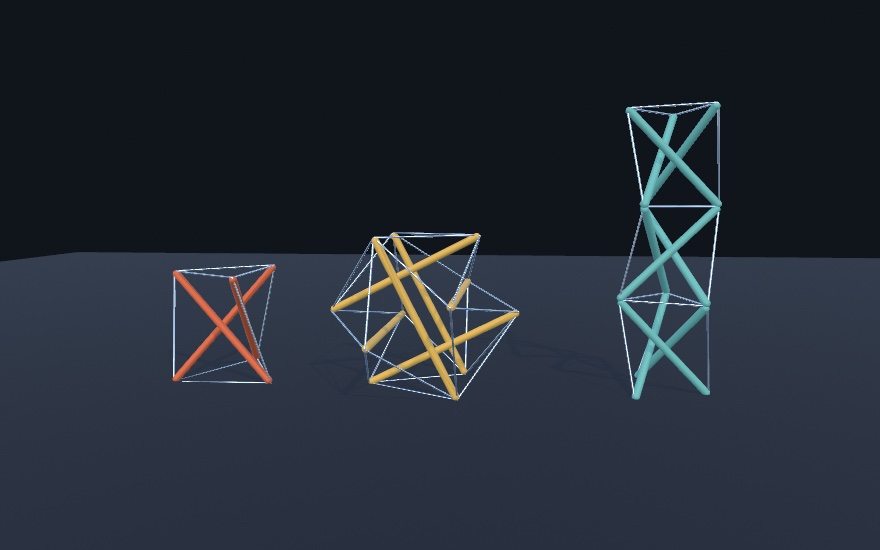
Contents
The three forms
| Form | Struts | Cables | What it is |
|---|---|---|---|
prism(struts:radius:height:twist:) | n | 3n | Two regular polygons of radius, the top raised by height and turned by twist. Each strut runs from a bottom node to the top node one step around. The simplest tensegrity. |
icosahedron(strutLength:) | 6 | 24 | Three pairs of parallel struts, one pair along each axis, each pair half a strut's length apart. The shape most people picture. Its nodes are the vertices of Jessen's icosahedron. |
tower(levels:struts:radius:levelHeight:) | n × levels | n × (2 levels + 1) | Prisms stacked on shared polygons, each level twisted the other way from the one below. Two struts meet at every shared node. |
A prism's default twist is the one that balances, prismTwist(struts:), a quarter turn less half the polygon's angle: π/2 − π/n. Thirty degrees for three struts, forty-five for four, sixty for six. It does not depend on the height or the radius.
Tensegrity.prism(struts: 4, radius: 1, height: 1.5)   // balanced, at 45°
Tensegrity.prism(twist: 0.2)                          // three struts at the wrong twist
Tensegrity.tower(levels: 5, struts: 3, radius: 0.5, levelHeight: 1)
Every form is a value. translated(by:), rotated(by:), and scaled(by:) move it, center and bottom say where it is, and endpoints(of:) and length(of:) read any member.
Balance
imbalance says how far a structure is from holding. It gives every strut the same push, finds the cable pulls that come closest to canceling it at every node, and reports the largest leftover force as a fraction of the mean pull. Zero means every node is in equilibrium. The three built-in forms read near zero. A prism at any other twist reads well above it, because no set of taut cables can balance its struts.
Tensegrity.prism().imbalance             // ~0
Tensegrity.prism(twist: 0.2).imbalance   // ~0.47
It is a check, not a fix. For a form of your own, read it before building.
Giving it weight
World3D.addTensegrity(_:at:…) builds the structure in a physics world and returns a Tensegrity3D. Each strut becomes a capsule body and each cable a .cable joint between two strut tips. Where two struts share a node, a .ball joint ties them there.
import OllinPhysics

let world = World3D()
world.ground = 0
let mast = try world.addTensegrity(Tensegrity.tower(levels: 3),
                                at: Vector3(0, 0.3, 0))   // a little above the floor; a tower always has struts apart

// each frame:
world.advance(by: deltaTime)
fill(.white)
drawTensegrity(mast)
The form falls, lands on its feet, and stands. Drag a strut with dragBodies(in:) and the whole thing follows and rights itself. remove(_:) takes it and all its parts out again.
prestressis how much shorter than its drawn length each cable is made, as a fraction. Default0.02. A real tensegrity is tensioned this way. With none, a landing can leave a cable slack and the form loose. The struts are rigid, so the cables cannot actually reach the shorter length; they sit a little over it, taut.stiffnessis the cables' give.1is inextensible. Less lets them stretch like a bungee, which softens every landing.strutRadius,density, andfrictiondescribe the struts. Friction is what keeps the feet from skating when it lands.
A prism built at the wrong twist and prestressed turns toward the balanced twist as it settles, because that is the only shape in which all its cables can be taut at once. It is a good thing to watch.
The .cable joint is the one new joint kind, and it is useful on its own. It holds two anchors no farther apart than length and does nothing when they come closer: a tether, a tendon, a guy line. A .distance joint is a rod; a .cable is a rope.
world.connect(mast, kite, .cable(from: mastTop, to: kiteNose, length: 4))Reading it back
A Tensegrity3D reads its own state from the struts:
strutsare the strut bodies, insource.strutsorder.cablesare the cable joints, insource.cablesorder.jointsBetweenStrutsare the ball joints at shared nodes.sourceis the geometry as built, in world coordinates. A strut of no length, a cable to a node no strut reaches, and that node are left out, so every member in it has a live counterpart.nodesare the live node positions.endpoints(of:)reads a member's two ends now.cableLengthsandcableRestLengthscompare each cable's length now with the length it was given;isSlack(_:)says whether one has gone loose.center,bottom,top,isAwake,wake(), andapplyImpulse(_:), which splits a shove evenly over the struts so the form moves as one.
drawTensegrity(_:cableRadius:) draws every strut as its capsule body and every cable as a thin capsule between the live nodes, in the current fill and material. For struts and cables in different colors, draw the struts with drawBody(_:) and the cables from nodes yourself.
A snapshot carries a tensegrity with the rest of the world: the struts and cables come back as bodies and joints, and the Tensegrity3D grouping comes back with them, reading the same nodes.
Building your own
A Tensegrity is three arrays, so any topology can be written down directly.
let form = Tensegrity(nodes: points,
                      struts: [Tensegrity.Member(0, 3), Tensegrity.Member(1, 4), Tensegrity.Member(2, 5)],
                      cables: cablePairs)
print(form.imbalance)      // near zero if it can hold
Nothing is checked at construction. addTensegrity skips a strut whose nodes coincide and a cable whose node no strut reaches, and throws PhysicsError.unbuildable if no strut is left. A cable may only join two different struts.
See also
- 3D physics, for
World3D, the joint kinds, anddragBodies. - Force-directed layout, the other structure here that finds its own shape.
- Chapter 30, Worlds with weight, which teaches it.