Ant colony
Ant-colony optimization looks for a short route that visits every city once. It works the way a colony of ants finds food, by leaving pheromone on the ground. In each iteration every ant walks a full tour, and it picks its next city by trail strength and by closeness. The whole map then evaporates a little, and every ant lays fresh pheromone along its tour, more of it for shorter tours. Good edges get stronger and bad ones fade, so the web condenses onto a short route.
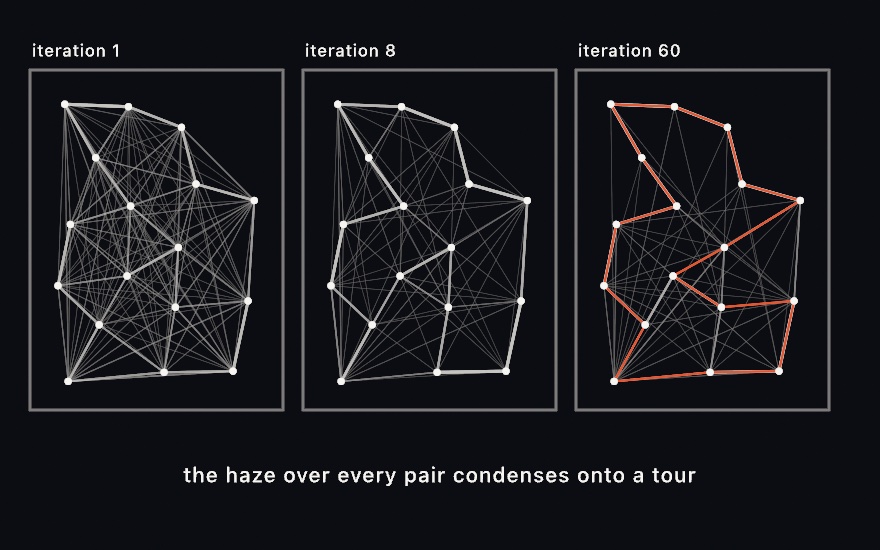
The web itself is the part worth drawing. trails holds the colony's current trail strength for every edge, so drawing it each iteration shows a haze of possibilities condensing into one answer.
AntColony is a stateful object that you hold on to. step() runs one full iteration, and step(_:) runs a batch of them. It is seeded, so the same seed searches the same way.
let colony = AntColony(cities: points, seed: 7)

override func draw() {
    colony.step()
    background(.black)
    for trail in colony.trails {
        stroke(Color.white.withAlpha(trail.strength * 0.8))
        drawLine(trail.a, trail.b)
    }
}
Contents
Building a colony
AntColony(cities: [Vector2], ants: Int? = nil, alpha: Double = 1,
          beta: Double = 4, evaporation: Double = 0.5,
          elitism: Double = 0, seed: Int = 0)
cities are the points to tour, and a few dozen of them make a readable web. ants defaults to one ant per city. alpha sets how strongly the trail counts when an ant chooses, and beta sets how strongly closeness counts. Raise beta and the ants become close to greedy, and drop it to 0 and they follow pheromone alone. evaporation is the rate at which the colony forgets. High values keep the ants exploring, and low values commit early, sometimes to a route the colony cannot get out of. elitism gives the best tour so far that many extra deposits per iteration, which sharpens the web onto the current answer.
Searching
step() runs one full colony iteration. Every ant walks a tour from its own random start, then the map evaporates, then every tour deposits pheromone, and finally bestTour and bestLength update. iterations counts how many iterations have run, and stepCount the full steps behind them. One or two per frame reads as a search you can watch, and a few dozen usually settle a small scatter. The best tour never gets worse, so you can stop whenever the web looks done.
Drawing the web and the answer
colony.trails                        // [(a, b, strength)], strongest edge = 1
colony.bestTourPoints                // [Vector2], for drawPolyline(closed: true)
colony.pheromone(between: i, and: j) // one edge's trail, symmetric
trails returns every city pair whose trail still matters. The strengths are normalized so that the strongest edge reads 1. Map strength onto alpha and width, and the web draws itself. Early iterations show a faint haze over every pair, and late ones show only the condensed route. bestTourPoints is the answer so far, ready to stroke on top. The Patterns/AntColony example shows the condensation as it happens.
Related: singleLine solves the same tour deterministically for the plotter path, so use the colony instead when you want to watch the search itself. The physarum simulation in Artificial life uses the same trail-following idea in a free-roaming field.