Volumes
A cloud, a column of smoke, a glowing gas, a drop of ink spreading in water: things with no surface, only a thickness that light passes through. A Volume is a box of density samples. drawVolume draws it in a 3D scene as a medium that blocks light, scatters the scene's lights toward the eye, and can glow by itself. Solids sit inside it: the medium in front of a solid veils it, and the solid hides the medium behind it.
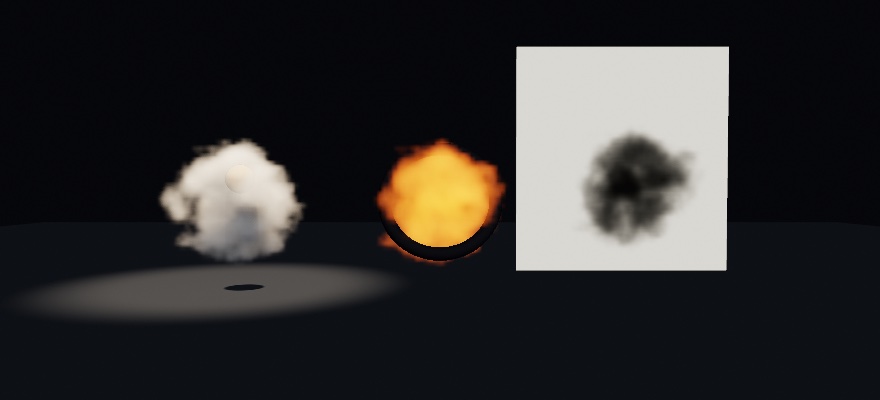
let smoke = Volume(width: 48, height: 48, depth: 48) { u, v, w in
    let fromCenter = Vector3(u, v, w).distance(to: Vector3(0.5, 0.5, 0.5))
    return max(0, fbm(u * 4, v * 4, w * 4) - 2 * fromCenter)
}
spotLight(.white, at: Vector3(0, 6, 0), direction: Vector3(0, -1, 0))
drawVolume(smoke, size: 4, medium: .smoke)
The grid
A Volume holds width by height by depth samples on a lattice that runs corner to corner across a box. x runs along the box's width, y up its height, and z through its depth toward the viewer. Between samples the value is read trilinearly, and outside the box it is zero. A value of 1 is the medium at its full thickness, and a value below 0 reads as 0.
Volume(width:height:depth:_:)calls a function once per sample withu,v,win0…1, corner to corner. This is the usual way to build one, from the sketch's ownfbm, a distance, or both.Volume(width:height:depth:values:)takes the samples in a list,xfastest, theny, thenz. A scan or a simulation's output arrives this way.Volume(width:height:depth:repeating:)is one value everywhere, a uniform block.Volume.noise(width:height:depth:frequency:octaves:seed:)fills a grid with fractal noise across every core. Each sample is thefbma sketch seeded withnoiseSeed(seed)reads, so it gives what the function form gives over thatfbm, only faster. The form withloop:andradius:reads noise that loops, so a grid refilled each frame comes back to where it started.
subscript(x, y, z) reads and writes one sample, and value(u:v:w:) reads between samples the way the march does. A volume is a value: copies share their samples until one is written. A grid reaches the GPU once, so a volume built in setup() costs nothing to draw again.
What it is made of
drawVolume(_:size:medium:) draws the grid filling a cube size units on each side, centered at the model origin, and drawVolume(_:width:height:depth:medium:) fills a box. Both follow translate, rotate, and scale like any solid. The Medium says what the box holds:
densityis how thickly the medium blocks light where the grid reads 1, per world unit, the unitfog(_:density:)takes. Light crossingdunits keepsexp(-density * d)of itself, which is Beer's law. At density 0 the medium blocks nothing.coloris what the medium does with the light it blocks: each channel, in linear light, is the share it scatters back out. White scatters everything, like a cloud. Black scatters nothing, like soot or ink, and only darkens.glowandglowIntensityare light the medium gives off itself, per world unit where the grid reads 1. A glow with no density adds over what is behind it, like a hot thin gas. With density, the deep glow is dimmed by the medium in front of it, so a thick glowing ball reads brightest at its center and settles at its glow divided by its density.anisotropy, from -0.95 to 0.95, is which way the medium scatters: 0 evenly, toward 1 mostly onward (a cloud with a light behind it shines at its edges), toward -1 mostly back. It is the same dialvolumetricLighttakes.
Medium(density:color:glow:glowIntensity:anisotropy:) builds one from these dials, and each is a property to change on a copy. The presets are .smoke, .cloud, .fire, .ink, and .nebula, and a @Param var medium: Medium = .smoke puts them on the inspector's menu. Every dial scales with the grid, so where it reads 0.5 the medium is half as thick and glows half as bright.
In front of and behind
Volumes draw after the frame's solids, over the finished picture. Each pixel's ray through the box ends at the first solid it meets. So a solid inside a volume is veiled by the medium in front of it and hides the medium behind it. Call order does not matter: a volume drawn before a solid in draw() still ends at it. Several volumes are drawn farthest first, by the distance to each box's center. So two volumes that pass through each other are ordered as wholes. Two boxes whose centers are the same distance away keep their call order, and the later one draws on top. A medium that only glows adds its light whatever its place in that order, so only an absorbing one needs placing. Drawn after a glow over the same box, it dims the glow. Drawn before it, it dims only what lies behind both. A volume drawn into a layer does the same over that layer's own solids. The same holds for 2D: a caption drawn after a volume in draw() lies under the cloud. Draw anything meant to sit on top in withOverlay { }.
Light and shadow
The medium scatters the scene's directional, point, and spot lights, with a spot's cone, its light profile, and its cookie. It also scatters the flat ambient and, under an environment, the environment's light from every side. The light reaching a point inside the medium has crossed the medium on its way there. So a cloud shades itself, lit on the side facing the light and dark on the far side. This self-shadow covers the first four lights in the frame, and further lights scatter without it. A solid between a directional or spot light and the medium throws its shadow into the medium, through the light's shadow map.
Some light is not followed:
- Light the medium bounces to itself is left out, so a thick white cloud lit from the front reads about half as bright as a white matte surface under the same light, and its shadowed side is dark rather than glowing.
- A panel or tube light scatters nothing in the medium. A point light's shadow, which has no flat map, does not fall into it.
- The medium casts no shadow on the solids around it, and a reflection or a refraction through glass does not show it.
- Fog veils the solids behind a volume, and the volume itself shows unfogged.
Where volumes go
- Exports. A still, a video, and the temporal anti-aliasing passes draw volumes. Under temporal anti-aliasing each pass starts its march at a different offset, so their average smooths the march's fine grain.
- Depth of field and motion blur read the depth and motion of the solid behind a volume, so a volume in focus in front of a far wall blurs with the wall.
- Not carried: a vector export (SVG) leaves volumes out, and a spatial export (USD) skips them. A web page export stops at
drawVolumeand names it, and the sketch exports as video instead.
What it costs
A grid reaches the GPU once, as half floats, so redrawing a volume costs only its march. Filling one costs what its function costs, once per sample. On an M2 in a release build, a 64-sample cube of Volume.noise takes 4.9 milliseconds. The same noise through the function form, on one core, takes 24.5. The looping form reads a larger noise lattice and costs about eight times as much: 5.8 milliseconds at 32 samples a side, 18 at 48, and 40 at 64. So a grid refilled every frame holds 60 frames a second at about 32 a side. Reading a grid built once, as the example does to scroll its noise, costs 3.8 milliseconds at 64 a side.
The march costs GPU time for each pixel the box covers, at two steps for every sample spacing it crosses. Each step takes a shadow tap and a transmittance read for each lit light. Each light's transmittance grid is worked out in a compute pass, and worked out again only when the volume, its placement, or the light changes. The Volumes example refills a 36 by 48 by 36 grid every frame, and the grid covers about a sixth of a 1080 by 1080 frame. Its march takes about 2.7 milliseconds of GPU time on an M2, with one spot light and its shadow. Framed closer, covering about a quarter of the frame, it takes about 5.
See also Atmosphere for fog that fills the whole scene and the light shafts in it, and the Environment.clouds sky for a cloudscape overhead. The Volumes example draws a column of smoke rising from repeating noise, with a ball hanging in it.